
Why Your Audiences Hesitate — and What CMOs Can Do About It
Written by Jessica Boyle, Account Director
May 19, 2026
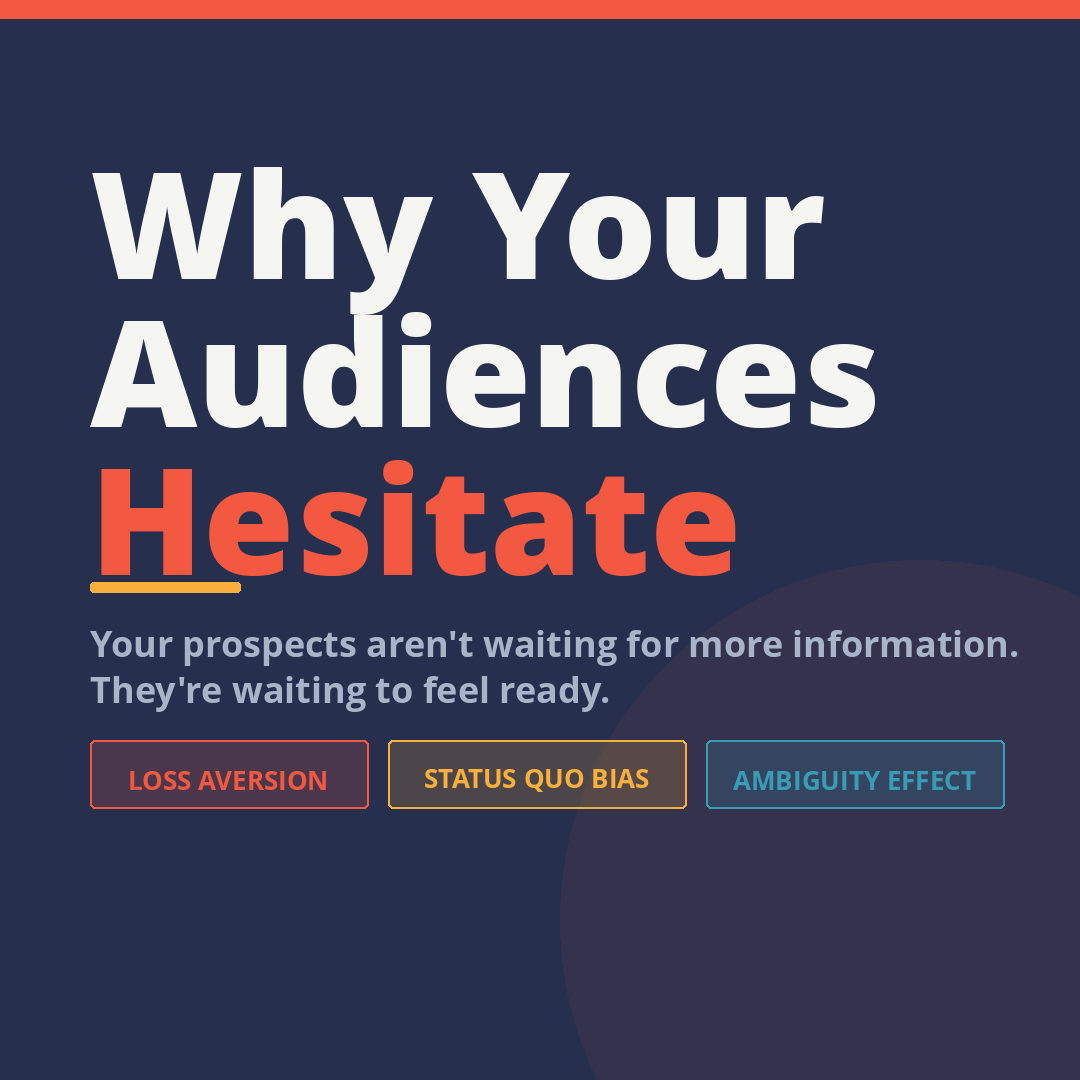
We've all been there. You know you should go to the gym. You've done the math on buying the house. You've told yourself a hundred times you're going to make the call. And still… nothing. Not because you lack information. Because the next step feels psychologically heavy.
That same force is working against your audiences every day.
A recent self-development article made an observation that applies surprisingly well to marketing: people rarely stay stuck because they lack information (especially in the world of AI). They stay stuck because taking the next step feels psychologically difficult.
The Psychological Architecture of Hesitation
Hesitation isn't passive. It's an active psychological state and understanding what's happening inside a prospect's mind at that moment is one of the most underutilized advantages a CMO can have.
When a qualified prospect goes quiet, the instinct is to layer on more: more content, more nurture emails, more retargeting. But behavioral economics tells a different story. The barrier isn't information deficiency. It's a specific cluster of cognitive forces working against commitment.
The first force is one every human knows intimately — the fear of getting it wrong. People are wired to weight potential losses roughly twice as heavily as equivalent gains. Psychologists call this loss aversion. A prospective student isn't just evaluating what they might gain from enrolling. They're mentally cataloguing everything that could go wrong — the debt, the opportunity cost, the possibility they chose the wrong program. A building specifier isn't just assessing product performance. They're thinking about their professional credibility if the spec fails in the field. A potential association member can see the value clearly and still hesitate, because joining feels like a commitment they might regret.
The second force is more insidious. Even when your audience openly acknowledges their current situation isn't working, it still feels safer than changing it. Psychologists call this status quo bias and it's remarkably powerful. A military recruit who is genuinely curious about service still has to mentally leave something behind to move forward. Change requires energy. It requires conviction. And conviction is hard to sustain when competing priorities pull in every direction. It's the same reason someone stays in a job they've outgrown, or keeps renting long after buying makes more financial sense. The known, however uncomfortable, feels safer than the unknown.
The third is the ambiguity effect: people consistently avoid options that feel uncertain, even when the expected outcome is favorable. In marketing terms, this means your audience may intellectually believe your organization, program, or product is the right choice, and still not move, because the outcome doesn't feel concrete enough to trust.
These aren't objections you can overcome with better messaging alone. They're hardwired cognitive tendencies that operate regardless of how compelling your creative is.
What This Means for CMOs
Understanding the psychology of hesitation changes where you focus your energy and how you measure whether your marketing is actually working.
The question shifts from "Are we generating awareness?" to "Are we actively reducing the psychological cost of commitment?"
That reframe has implications for how you architect the experience.
Minimize the activation energy of the first move. The larger the perceived commitment, the stronger the hesitation response. This isn't just about price or complexity, it's about cognitive load. Every element of friction in the path to commitment amplifies that mental weight. A prospective member weighing whether to join an association isn't just thinking about dues. They're thinking about time, relevance, and whether the community will be worth it. The best marketing removes that friction before it takes hold — low-stakes entry points, clear preview experiences, and visible off-ramps that make starting feel safe.
Make inaction feel riskier than action. Loss aversion cuts both ways. If your audience is wired to overweight losses, show them what staying put actually costs. Not as a pressure tactic, but as an honest reframe. What does a student lose by deferring another year? What does a building team risk by defaulting to a familiar but underperforming specification? What does an individual forfeit by not investing in the right training or credentials now? This isn't fear-based marketing, it's accuracy-based. The cost of inaction is real, and our job is to make it visible.
Replace ambiguity with specificity. Your audience may believe you're the right choice and still not move. Not because they distrust you, because they can't yet see themselves on the other side of the decision. Vague testimonials and generic impact statements don't solve this. What moves hesitant audiences is highly specific proof: someone who faced the same uncertainty, came from the same starting point, had the same concern, and made the commitment. The more your proof mirrors their situation, the more the brain can project a concrete outcome.
Design for the decision moment, not just the journey. Most marketing is optimized for discovery and consideration. But the decision moment, where your audience actually has to commit, is where psychological weight is highest and where most marketing goes silent. Think about the last time you were about to sign something significant — a lease, an offer letter, a major purchase. All the research was done. And yet that moment still felt different. A recruit who has attended every information session still needs something different at the moment of enlistment than they needed six months earlier. A specifier who has reviewed all the technical data still needs reassurance at the point of final specification. What does your audience need to feel, not just know, at that exact moment? That's where creative, messaging, and media should be working hardest — not just at the top of the journey.
The Competitive Advantage Hidden in Plain Sight
Think about the last big decision you delayed longer than you should have. Chances are you knew what you needed to know. What you needed was to feel ready and nothing in your environment was helping you get there.
Your audiences are no different.
Most organizations are fighting for attention. Fewer are thinking seriously about what happens after they have it. A CMO who understands the behavioral science of hesitation doesn't just produce better campaigns. They build marketing systems that account for how human beings actually make decisions under uncertainty, with competing priorities, and a strong pull toward staying put.
The audiences in your pipeline aren't waiting for more information. They're waiting to feel ready.
Your job is to close that distance.