
The September decision shift:
What high school seniors teach us about high-stakes choices
Written by: Jessica Boyle, Account Director
September 8, 2026
For most of high school, the question is broad and hypothetical: What do you want to do someday? September changes the question. Then a new school year begins, the calendar tightens, and the abstraction collapses into something immediate. Juniors and seniors are no longer imagining a future. They are being asked to choose one.
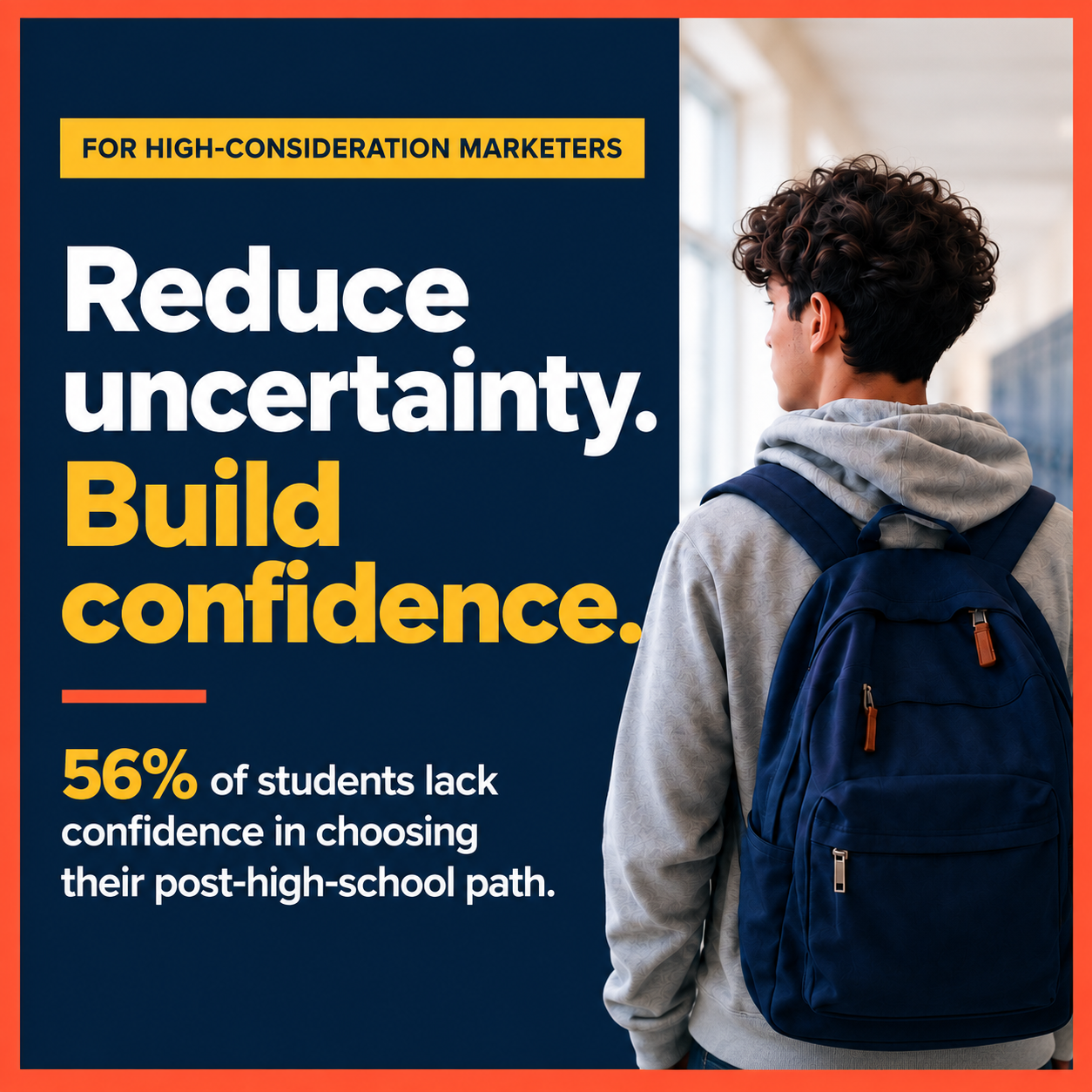
This is a specific behavioral moment, and it is more pressured than we tend to assume. Research from ACT, published in February 2025 and drawing on responses from 4,157 juniors and seniors, found that 56% lacked confidence they would make a good career decision. More than half of the students standing at the threshold of one of the most consequential choices of their lives did not trust themselves to get it right.
That gap between the pressure to decide and the confidence to do so is the real story. And it holds a lesson that extends far beyond graduation season.
The competitive set is bigger than we think.
Marketers in high-consideration categories tend to define their competition narrowly. A university sees other universities. A branch of the military sees other branches. An employer sees rival employers.
The audience does not see it that way. When Third Way and Global Strategy Group surveyed 1,002 U.S. high school students in August 2024, they found students weighing fundamentally different pathways at once: 71% considered a four-year college, 40% community college, 37% full-time employment, 27% trade or vocational school, 16% an apprenticeship and 13% military service.
These are not variations on a theme. They are entirely different lives.
The audience defines the competitive set, and they define it more broadly than any single brand or institution would like. A student is not choosing between your college and another college. They are choosing between college and a job, or a degree and a trade, or structure now versus structure later.
This is true wherever the stakes are high. Marketers who map only their direct competitors miss the choice their audience is actually making.
Information is not the same as clarity.
The instinct, when an audience is uncertain, is to give them more information. The assumption is that uncertainty is an information deficit, and that filling it produces confidence.
The evidence complicates that assumption. In the same ACT study, 54% of students did not know the steps needed to make a career choice, and 46% found deciding difficult because there were too many options. Only 49% felt prepared or very prepared to choose a direction.
These are not students lacking access to information. Many are struggling to make sense of the information in front of them.
Information tells people what exists. Clarity helps people understand what it means to them. Those are different functions, and most high-consideration marketing does only the first.
The more useful question is not "What do they need to know?" but "What uncertainty can we remove?" For most audiences facing a life-changing choice, uncertainty falls into four recognizable categories:
Relevance: Is this for me?
Process: What happens next?
Consequence: What am I committing to?
Proof: Have people like me made this choice successfully?
Answer those, and the volume of information matters far less. When the stakes are high, clarity is not a nice-to-have.
Discovery and influence are not the same thing.
There is a temptation to conflate where audiences encounter a message with what actually moves them. But, the channel that earns attention is not always the source that earns trust.
A June 2025 study from Gallup, the Walton Family Foundation and Jobs for the Future, based on a probability sample of 1,257 K-12 students, drew the distinction sharply. Asked whom they trust for guidance on life after high school, students named parents (90%), teachers (54%), counselors (48%) and friends (39%). Social posts from people they know landed at 9%. Social posts from strangers, at 8%.
Social media may be where discovery happens. But when a decision becomes serious, students turn to very different sources for trust and validation.
High-consideration decisions happen within a network of trusted people. The student is at the center, but the decision is shaped alongside parents, mentors and peers, each helping with different concerns. A message that reaches only the decider ignores the people the decider will turn to before committing.
The same study found a second gap: only 15% of students said their school gave them a lot of information about pathways not requiring a college degree, and 43% received little or none. When trusted sources provide little information about an option, marketers face a much harder job turning awareness into serious consideration.
Reach the audience. Then equip the people they trust.
High-consideration marketing builds confidence, not urgency.
Return to the student in September, facing a decision that feels both enormous and premature. The reflex in performance marketing is to manufacture urgency: limited seats, closing windows, act now.
But adding more urgency to an already pressured moment can be counterproductive. What moves a hesitant, high-stakes decision forward is confidence. And confidence is built, not demanded.
At LMO, we have spent decades marketing the decisions that shape people's lives: education, careers, military service, and other significant commitments. Across all of them, the same pattern holds. The most effective organizations are not the ones that shout the loudest or push the hardest. They are the ones that make a hard decision feel possible.
Confidence-building marketing provides clarity about what the choice actually involves, relevance that lets people see themselves in the outcome, proof from people with comparable experience, realistic expectations, trusted validation and a next step small enough to take without feeling like the whole commitment.
This is less about pushing harder than removing what keeps a willing person from moving: friction, uncertainty, and fear.
Help people decide. Do not just ask them to.
The question worth changing.
September will keep arriving, and every year another cohort will move from imagining a future to choosing one. What is true for them is true for anyone facing a decision that matters: the obstacle is rarely a lack of options or a lack of information. It is a lack of confidence.
That should change the central question marketers ask. Not "How do we persuade them to choose us?" but "What uncertainty can we remove so they can choose at all?" The first question is about the brand. The second is about the person. Only one of them earns trust.
When the stakes are high, marketing should help people move from uncertainty to confidence. That is where the real work begins.